Tony Takitani and his wife’s marriage
Blind Willow, Sleeping WomanTony Takitani and his wife’s marriage marks a brief but decisive change in Tony’s life: an intimacy he had never expected makes loneliness bearable, only for her sudden death to leave him with a roomful of clothes and no way to recover the life they shared.
Before the Marriage
Tony had known several women and once lived with one, but he had not considered marriage or children necessary. He managed his household independently, had no close confidant, and generally preferred listening to people over talking about himself. Although others liked him, his relationships did not extend beyond everyday acquaintance. He saw his father, Shozaburo Takitani, only every few years on business, and neither had much to say once it was done. Tony had concluded that he would probably never marry.
That settled solitude broke when a 22-year-old publishing-company part-timer came to his office to collect an illustration. She was fifteen years younger than Tony, and her appearance was unremarkable, but something about her immediately left him unable to breathe easily or explain his attraction. He was also struck by her clothes: she wore them with a naturalness and pleasure that seemed to give the garments a life of their own. After she left, he remained at his desk until the room grew dark.
Courtship and Shared Life
The next day Tony arranged for her to return, then invited her to lunch. They found they had much to talk about and quickly became comfortable together. She admitted that most of her pay went toward clothes. Their first dates were similarly quiet: they sat and talked about their backgrounds, work, and thoughts, seeming to fill each other’s emptiness. At their fifth meeting, Tony asked her to marry him.
She hesitated. She had been dating a high-school boyfriend for years, though their relationship had become unhappy and their meetings often ended in arguments. She also wondered what the age difference would mean, and asked for time to think. While she considered the proposal, Tony could not work and drank alone; the solitude he had scarcely noticed before became oppressive. He told her how lonely his life had been and what her presence had made him understand. She liked him and believed she could be happy building a life with him, and they married.
Marriage brought Tony relief, but also an anxious awareness of how much he now depended on his wife’s presence. In the first three months, he looked for her as soon as he woke and searched the house if she was not beside him. The fear of losing the new happiness eased as he grew accustomed to their shared life. They did not fight, and spent happy hours walking, going to movies, and traveling. She was capable and efficient at home, and Tony’s work continued successfully.
The marriage also brought Tony back into contact with his father in an unfamiliar way. At his wife’s suggestion, the couple went to hear Shozaburo play in a Ginza nightclub, the first time Tony had heard him perform since childhood. The music recalled the records he had listened to as a boy, yet seemed subtly different; Tony could not explain the difference or ask his father about it. He listened through the set with whiskey and water, then went home with his wife. The episode places the marriage beside Tony’s estranged family connection, without resolving that distance.
Clothing and the Marriage’s Strain
His wife’s pleasure in dressing gradually became an inability to stop buying clothes. The habit intensified during their European honeymoon: in Milan and Paris she visited boutiques all day, and they saw neither the Duomo nor the Louvre. She bought from designers including Valentino, Missoni, Yves Saint Laurent, Givenchy, Ferragamo, Armani, Cerruti, and Gianfranco Ferré, while Tony paid the bills. Back in Japan, she continued buying almost daily. He had large armoires and a shoe cabinet made, then converted an entire room into a walk-in closet, but the clothing still overwhelmed the available space.
Tony initially accepted the spending because money was not a problem and his wife looked happy in the clothes. He changed his mind after counting her dresses: she could wear a different outfit twice a day for nearly two years without repeating one. He raised the issue after dinner, emphasizing that he was concerned by the quantity, not the expense. His wife agreed that she did not need so many dresses, but said she could not resist buying a beautiful one. She compared the compulsion to drug addiction and tried to stop by staying home for a week. Surrounded by her clothes, she handled and tried them on, and found that looking at what she owned only strengthened her desire for something new.
Because she loved and respected Tony, she attempted a concrete act of restraint. She returned a coat and dress, bought ten days earlier and never worn, to a favorite boutique in Aoyama, then drove home in her blue Renault Cinque. She felt lighter at first, but while waiting at a red light became preoccupied with the returned clothes—their colors, cut, and texture. When the light turned green, she accelerated. A truck crossing on a yellow light struck the side of her car. She died without feeling the impact.
Bereavement and the Clothes
Tony was left with a room of size 7 dresses and 112 pairs of shoes. He sold some accessories to a dealer for the first offer, burned the stockings and underthings, and could not bring himself to deal with the remaining clothes. After the funeral he shut himself inside the walk-in closet and stared at the dresses. He later advertised for a female assistant with his wife’s approximate height, dress size, and shoe size, intending to have her wear the clothes as a uniform while he adjusted to his wife’s absence.
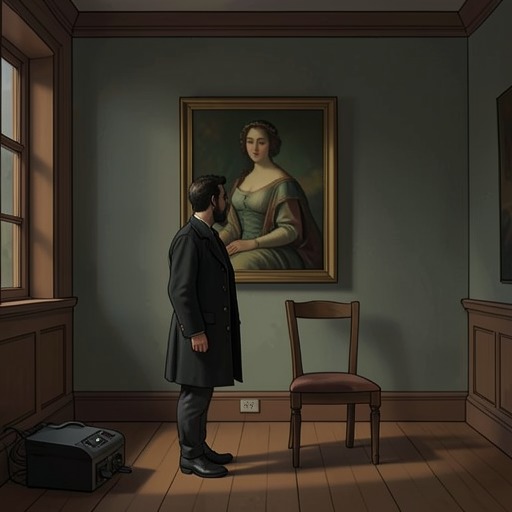
The woman he hired spent considerable time choosing six days’ worth of dresses and matching shoes. When she entered the clothing room, she began to cry. To Tony, the garments had first appeared as his wife’s shadows; looking at them after the woman left, he understood them as objects that had been separated from the living person who had worn them. Their colors and details seemed to press upon the room, while the clothes themselves had become meaningless to him. Loneliness returned. He called the assistant and canceled the job, telling her to keep the clothes she had taken, along with the suitcases, and asking her not to tell anyone about the arrangement.
Tony eventually let a used-clothing dealer take everything his wife had left. The dealer paid less than a twentieth of what Tony had spent on the garments, but getting them out of sight mattered more than recovering their price. He left the emptied room bare for a long time. From time to time he sat there for an hour or two, looking at the walls and the shadows of what had been there. As months passed, he lost the colors and smells of the clothes and even the vivid emotions attached to them. His wife’s face sometimes became difficult to recall. What endured with unusual clarity was the image of the assistant crying among the dresses, a stranger whose name Tony later forgot.
Significance of the Relationship
The marriage moves Tony from a life of self-sufficiency and limited human closeness into a happiness that makes his fear of loneliness newly tangible. His wife’s clothing is at once a pleasure she shares with him, a compulsion she struggles to restrain, and the material remainder of a person who cannot be brought back. Tony’s attempts to keep the garments close, to have another woman wear them, and finally to remove them from his house do not restore the relationship; each response measures a different limit of what objects can preserve.
The room’s gradual emptiness parallels the fading of Tony’s memories, but forgetting does not erase bereavement cleanly. The clothes and their smells recede, and even his wife’s face becomes uncertain, while a stranger’s quiet grief remains sharply remembered. The marriage ends with his wife’s death, but its lasting consequence is the sense of absence Tony carries after the physical traces—and much of the remembered detail—have gone.